
What is Organic Sunscreen?
Today someone posted on Facebook, “Save the Planet, Use organic sunscreen, it pollutes less”
Sounds great! what could be better than to save the planet? Why use those awful “chemicals” that “pollute” everything, when you can use “natural” substances, that would never pollute anything?
It turns out there may be a grain of truth in this. According to NOAA’s National Ocean Service, a primary component of many sunscreens, benzophenone-2, will damage and even kill coral polyps. This same compound may also be harmful to the people who spread it on their skin too.
That said, let us explore the idea of “organic” sunscreen. The word organic has a variety of meanings. In Chemistry, an organic molecule is one which is composed of carbon (C), hydrogen (H) and oxygen (O). The term originates from the fact that these three elements are the primary building blocks of all living organisms. Hence organic. But organic compounds do not have to be of biological origin. Most pesticides, from DDT to Agent Orange are organic compounds, even though they are made in a factory.. Organic compounds of natural (biological) origin include some of the most deadly toxic substances known to mankind.So from the point of view of chemistry, organic does not equal safe or non-polluting.
Another use of the word organic comes from agriculture. It is based on the use of fertilizers of organic origin (such as manure), rather than ones manufactured in a chemical factory (such as ammonium nitrate). The term was expanded to include a ban on pesticides as well (though most are organic chemicals, some are not of organic origin).
Various countries and regions have their own system of certifying food as “organic”. In the US, for a product to be certified organic, all of its components have to be certified organic as well, and they all have to be edible. Sunscreen made entirely of edible components should be reasonably expected to degrade quickly in the environment, making it less polluting. Although I am not sure I want to fall asleep in the tropics, slathered with a thin layer, of salad dressing.
But sunscreen has to be effective: it has to either absorb or reflect ultraviolet (UV) light before it is absorbed by your skin. UV is high-energy radiation; so high in energy that it can break chemical bonds. It is this breaking of bonds that allows UV to damage DNA in the skin, and possibly cause cancer. So any component of sunscreen meant to block UV radiation by either absorbing or reflecting it has to resist being broken down by the UV light itself. Benzophenone -2 absorbs UV radiation without photodegrading, and is colourless. That is why it is found in so many sunscreen products. So what substitutes are available?
There are commercially available sunscreens without Benzophenone-2. Some of them use non-photodegradable compounds similar to BP-2. The rest use oxides of zinc or titanium. Zinc oxide is effective, not photodegradable, and is not absorbed into the body as long as it is not ground down to the nano-particle size. It works by reflecting the UV light, so it is bright white. Titanium oxide is similar but less readily available. Either way, these are not sunscreens that you can slather on and look the same: they whiten the skin.
i had a read through some home-made sunscreens. Essentially they are made up of three main components:
1. Something to reflect sunlight: oxides of Ti or Zn.
2. Something to mix #1 and spread a thin layer over the skin and keep it there. This is usually a mixture of oils, like shea butter and coconut oil.
3. A waterproofing agent, beeswax. This thickens the oil and makes it resist being washed away by sweat or swimming. It helps the sunscreen stay on longer, but not forever, so reapply regularly anyway.
4. Preservatives. If you plan to leave your sunscreen out in the heat, you might need a little sodium benzoate to keep it from spoiling. Otherwise, just make small batches. and keep it in the fridge.
5. Everything else is for scent or colour.
Zinc oxide is not organic in the sense that it is an organic compound, nor that it is made by plants or animals. It is a mineral, extracted from the soil and processed to purify it. Somehow it gets a pass though, as people can say it is obtained from natural sources. So is the gasoline in your car, but hey, who’s counting? The point is that it is better than the UV-resistant organic chemicals like benzophenone-2 and all its relatives.
Basically, any substance with “benz” or “phen” in it is going to be resistant to degrading, which means it will persist in the environment long enough to do weird things to living creatures. When will we learn?
Upshot:
Regular sunscreen is probably harmful to the marine environment. If your sunscreen has Benzophenone-2 in it, it is definitely harmful, at least if you are swimming near corals. Any other benzo-s or pheno-s are likely bad too. If you are going to be swimming or snorkelling in warm seas, leave that stuff behind.
You can make your own sunscreen easily enough out of zinc oxide cream, thinned with baby oil. Or follow any of the many recipes available online. Prepare to be whitened.
Tip:
Don’t rely on sunscreen more than you need to. Wear a hat. Stay in the shade unless you are tanning or just can’t avoid it. Wear light clothing with long sleeves and pants as much as possible.
Paddling around San Carlos
Much of the Sonoran Coast is low coastal plain, gradually sloping to a line of dunes, then an endless beach, or broken into a string of sandy barrier islands covered with mangroves, backed by a shallow lagoon. Such a coast is not the best paddling water. The endless beach sounds good, but it means you have to launch and land in surf. The mangrove/barrier island sections of the coast make for safer landings, but they are infested at dawn and dusk with clouds of sandflies and mosquitoes. And from the water, the landscape is flat and featureless.
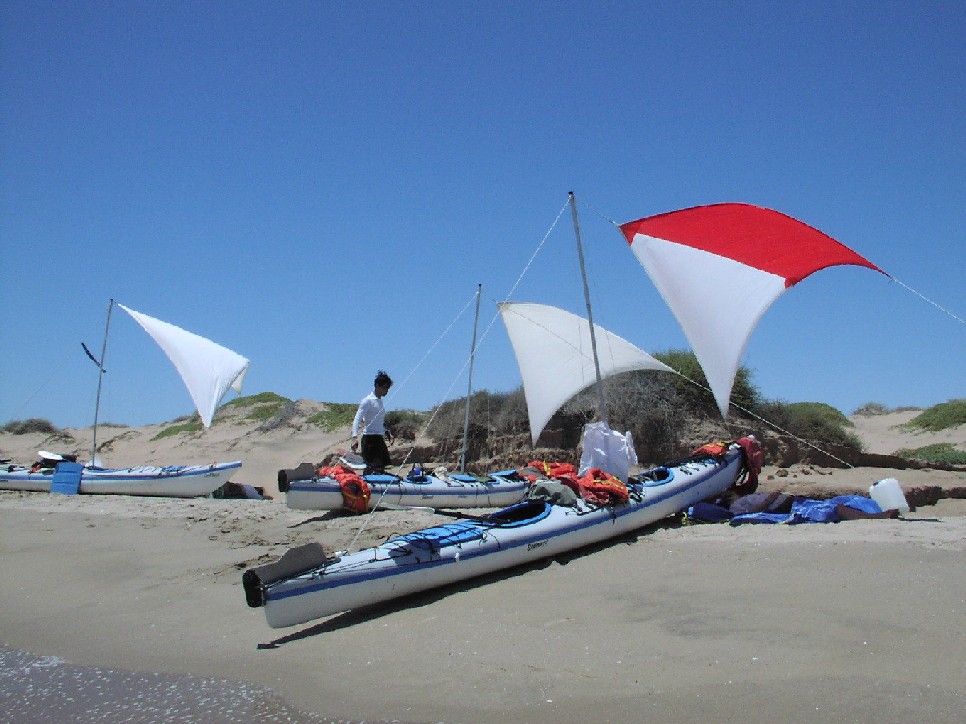
Broad beaches backed by low dunes make a picturesque picnic site, but getting in and out of the water can be hazardous. The sails are positioned for shade.
But there is one stretch of coast where a range of low mountains runs right into the sea. Here the coast is jagged and rocky, with high headlands and deep, sheltered coves. This range, called the Sierra el Aguaje, runs from just south of Guaymas, north through San Carlos to Tastiota, encompassing about 40 miles of coastline.
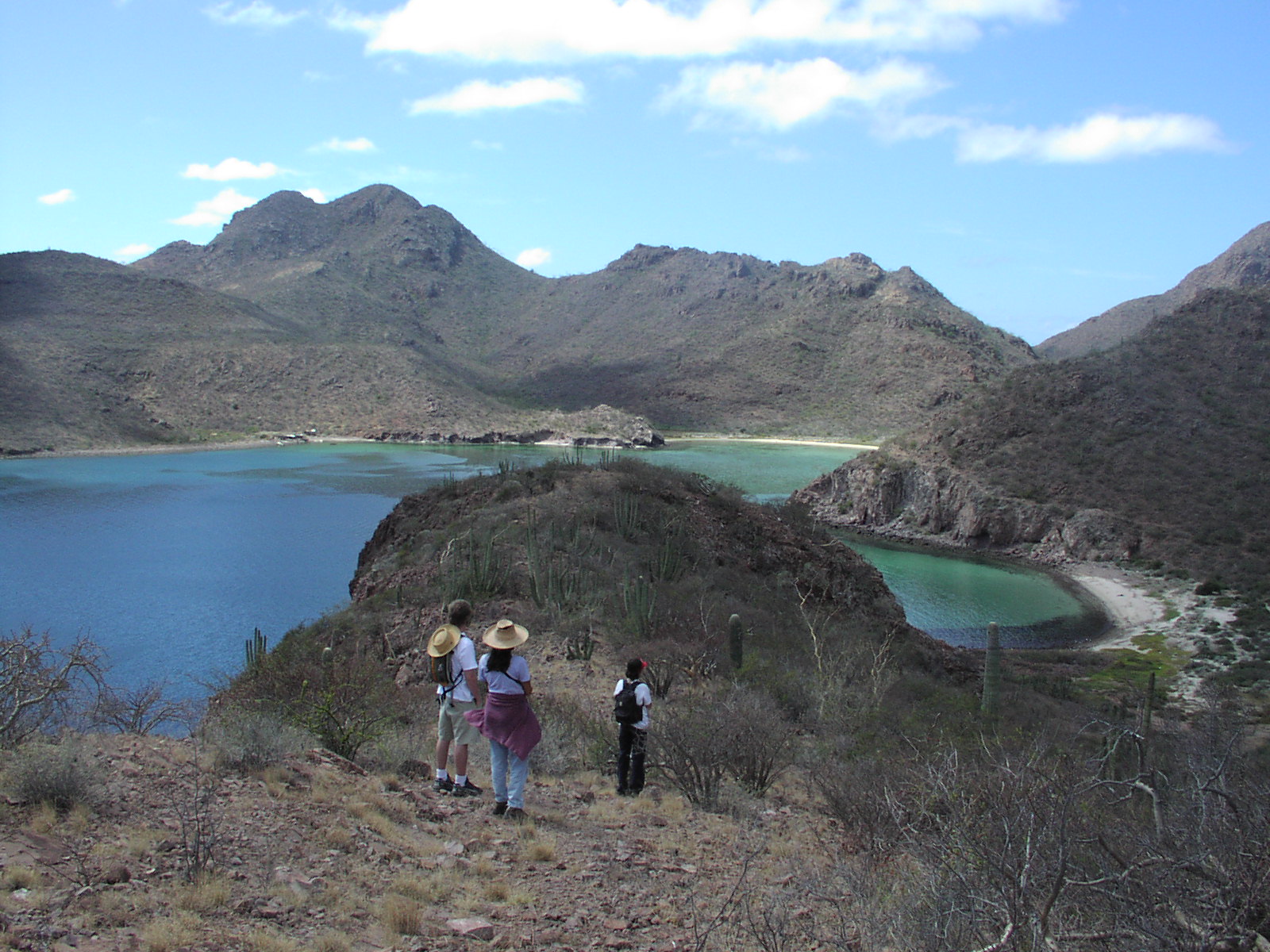
Rocky headlands alternate with sheltered bays with sandy or gravelly beaches. Protection from surf means easy and safe launchings and landings. The rocky shore is good for fishing and snorkeling and for collecting dinner. It’s also a good place for a hike.
This coast is much more interesting, from a distance, and up close.
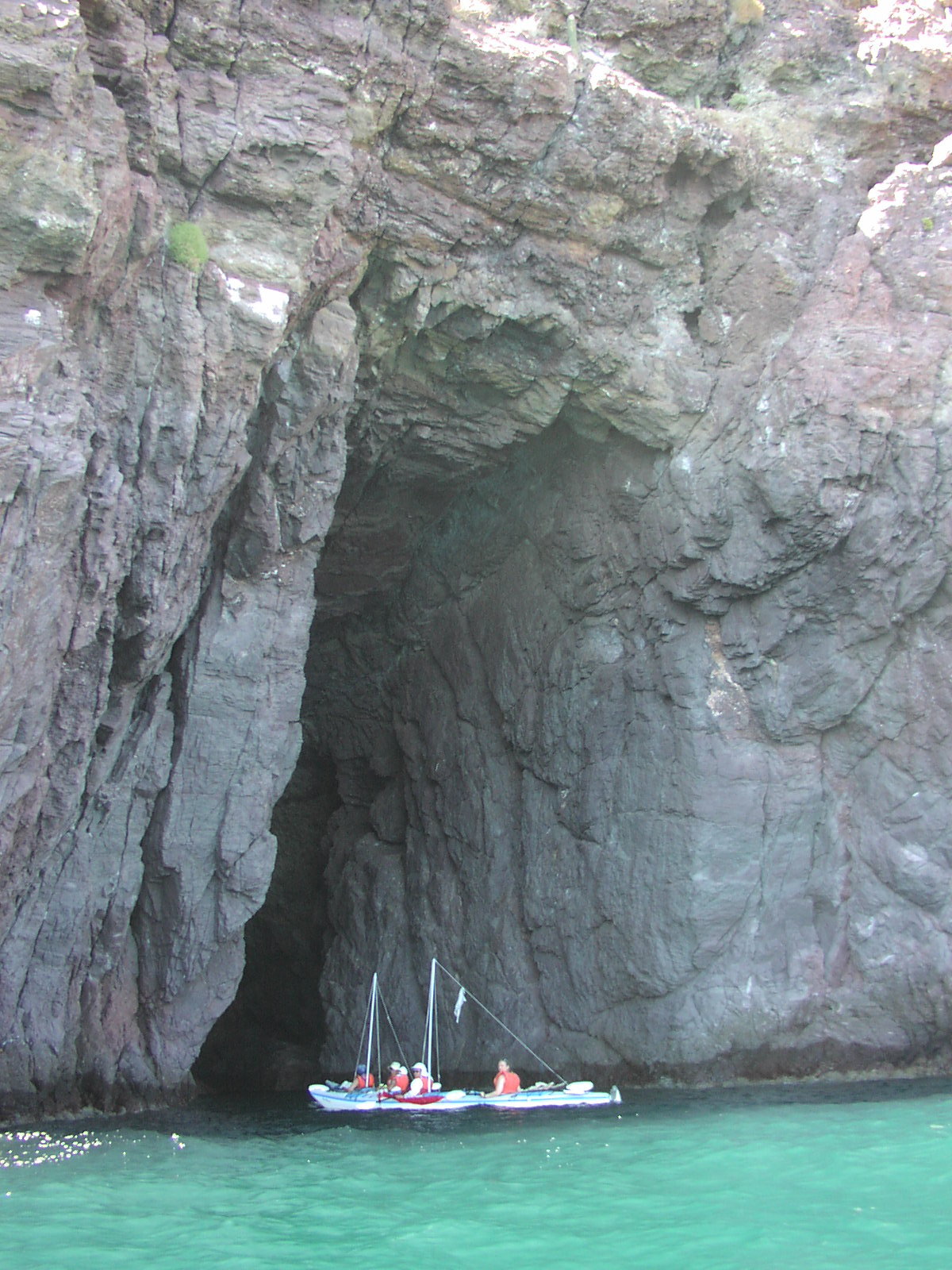
Poking our noses into one of the many caves.
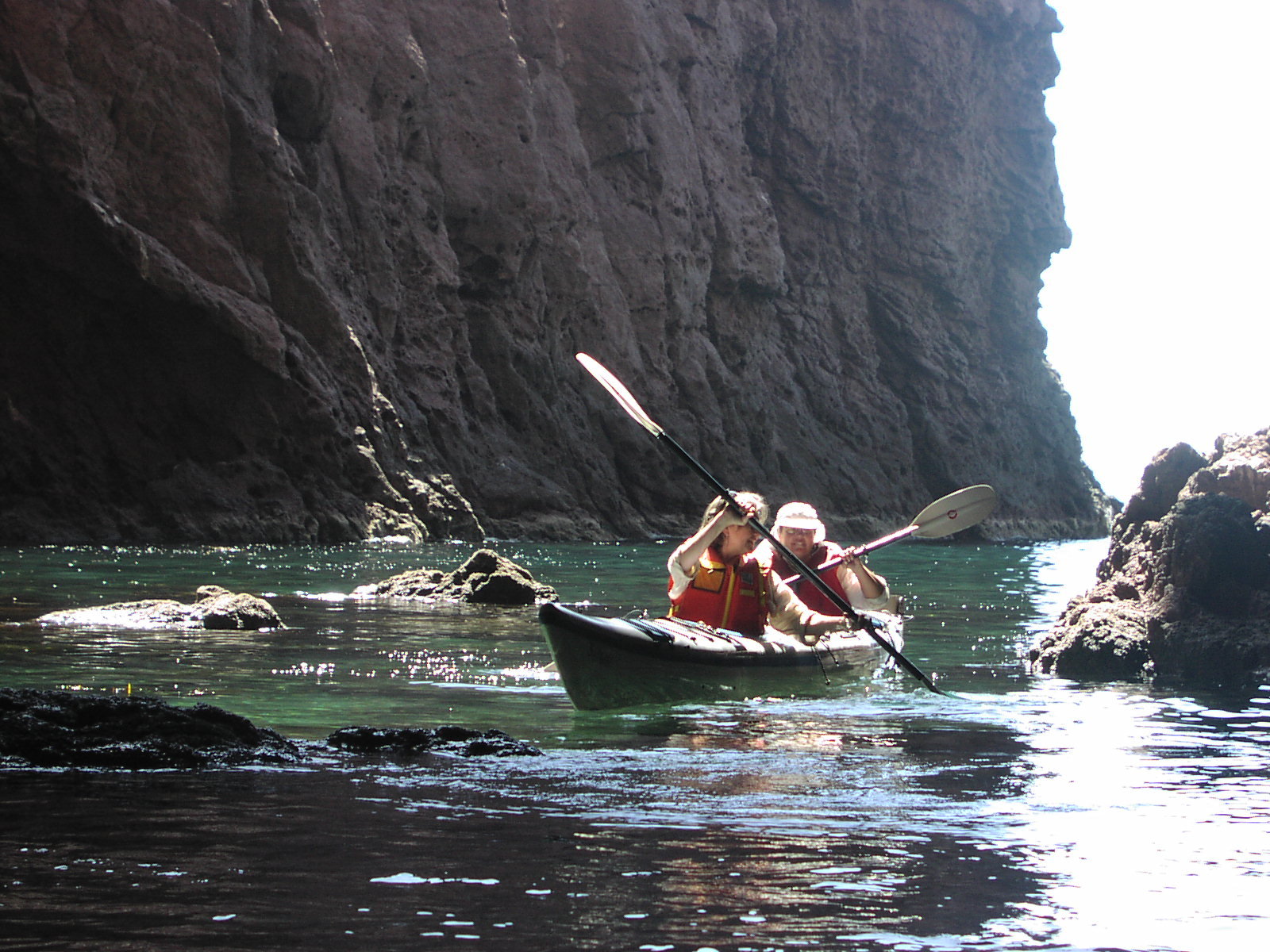
Swell-driven currents swirling around submerged rocks make manoeuvrng tricky as a pair of intrepid paddlers enter a sea cave.
Kayaking is not blue-water sailing: we want to be among the reefs and shallow areas. Here, in the clear water, we can see schools of fish, watch birds diving for their dinner or resting on the cliffs, and playwith the waves and currents. And the rocky coast of the Sierra el Aguaje is the best place in all of Sonora to get our blades wet and have some fun.
Light show at Half Moon Caye
Having recently returned from Belize, I will be posting some stories of my recent experiences in that awesome country, and especially from Half Moon Caye at Lighthouse Reef, in the Caribbean Sea.
There is nothing like a good thunderstorm for evening entertainment at Half Moon Caye. But this one was unlike anything I had seen before. Not because of its intensity, but because of its duration, and the strange shapes and patterns it drew in the night sky.
Thunderstorms at sea more commonly happen at night than during daylight hours. This is because the sea cools down so slowly, compared to land, and it is usually the temperature difference that is the final trigger for the electrical activity. Vertical air movement builds up a static charge between cloud layers, and when the charge is great enough, electric currents will connect the charged layers with explosive results.
We were expecting a weak cold front to arrive in the evening. All day the clouds had been building, and winds were unusually light. As darkness set in, the clouds started to pulse with light. This went on eerily, for hours, with no thunder, none of the crash and boom you associate with a proper thunderstorm.
When the storm finally reached I was sitting with my good friends Doug and Jan Kilburn and my new friend Robert, sipping single-malt scotch. For three hours, the light show danced overhead, in great, branching streaks. Lightning was so frequent as to be almost constant, but when a gap appeared we were plunged into utter darkness. Then it would start up again and entrance us with its weird shapes.
Lightning that hits the ground (properly called Ground-to-Ground or GG), usually follows a main lead, hundreds of times brighter than the many leaders that don’t quite make the connection. This is what we think of as a “bolt’ of lightning. But this storm was all within the same cloud (Intra-cloud or IC), an intricate branching of leaders, all of roughly equal brightness, that etched the sky with what looked more than anything like the roots of a great tree.
Perhaps the single-malt helped, but this was definitely the best light show I have ever experienced. And what better place to view such a show, than here, on Half Moon Caye.
Home Early
I injured my back in Belize, so I came home early. I haven’t seen the Sonoran Desert in April in over a decade, so it is a nice surprise to see the palo verde trees in bloom and to enjoy warm dry days and mild nights.
I can’t endure sitting in a kayak just yet, and the sea isn’t warm enough to snorkel in, so I am confined to bed rest and soon I will do some light hiking. This is my first post on this new blog, so my rambling is more to fill space and see how it looks than to enlighten anyone who might be out there.
The purpose of this blog is to chronicle my life. Topics will range from the natural history of the Sonoran Desert and Sea of Cortez, to life as an ex-pat, to random musings on events worth noting. Hopefully worth noting to someone, but no matter. A blog is always an exercise in narcissism. Cheers.


 jackwildeadventures
Recent Comments